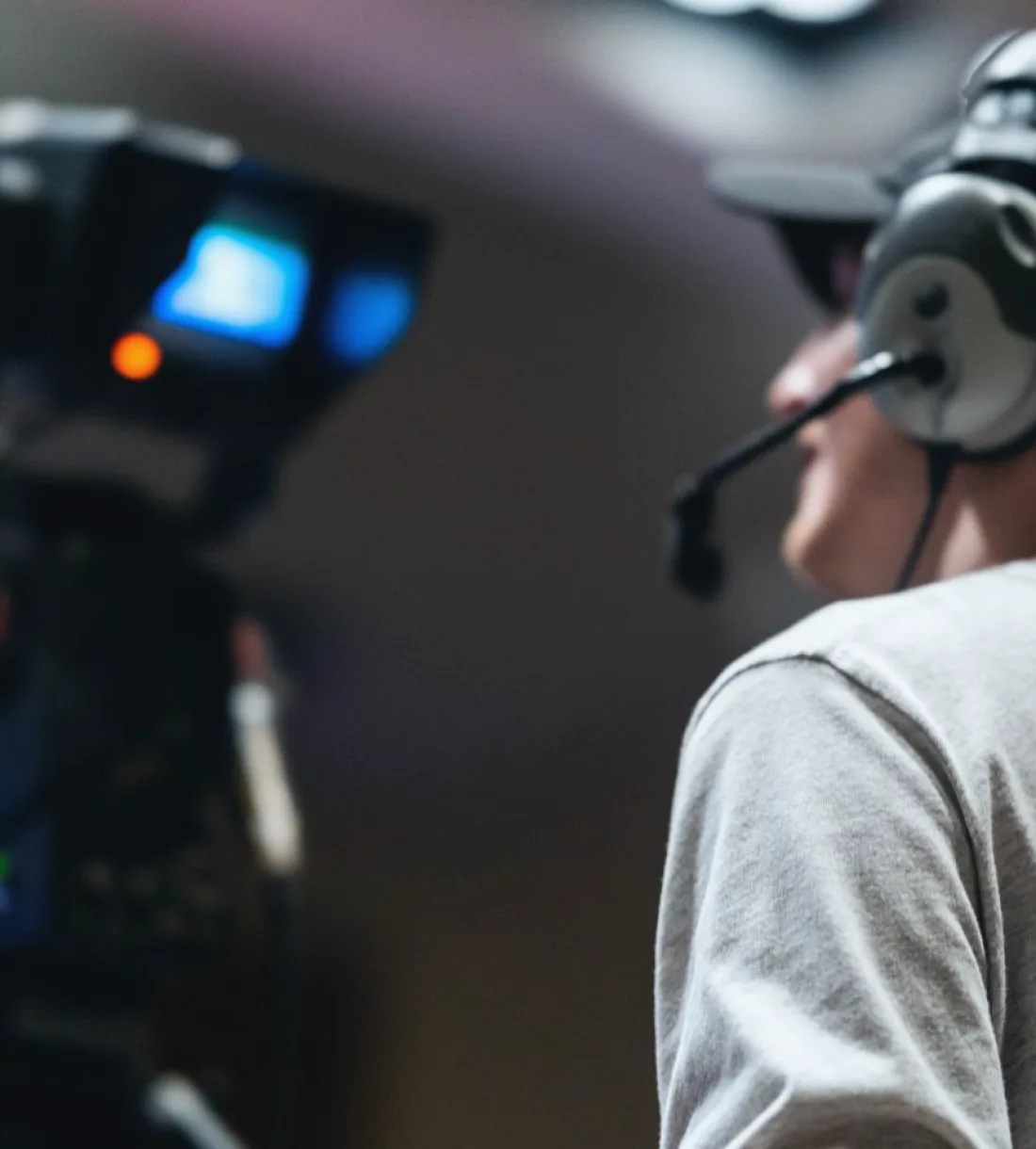
How many cameras does an interview or live show really need?
The question we hear most often about camera work: how many cameras, how many operators, and who calls the shots. Straight answers for interviews, bulletins and stage shows.
EG
Ewan Gordon
6 min read
The question behind the question
Almost every first call we take about camera operation and direction contains the same sentence: how many cameras do we need? It sounds like a hiring question, but it is really a question about what the viewer should see and how much can go wrong while they watch.
I am an audio engineer, so I come to this from the other side of the gallery. I hear the consequences of camera decisions: a presenter who keeps turning to find a lens, a guest who is cut off mid-sentence because the director had nothing else to show. Those problems rarely come from too few cameras alone. They come from a plan that was made without asking what each camera is for.
The honest answer is that the number follows the format. A format with one speaker and a fixed set needs a different crew from a panel with four chairs, and both are very different from a concert stage. What follows is how Isla Campbell and the camera crews we work with usually think it through.
Single presenter bulletins
A news bulletin read by one person from a desk can be covered by a single camera, and plenty of regional programmes are. The shot is predictable, the framing barely moves, and an experienced operator can hold it for the full running time without drama.
The weakness of one camera is that nothing is left if it fails, and the picture never changes. Adding a second camera on a slightly wider or off-axis angle gives the director somewhere to go for a change of pace, and it gives the gallery a safe cut if the first shot drifts or a prompt line is missed.
For a short bulletin we would usually suggest two cameras, one operator each, and a director who can also cut. For anything that runs longer than a quarter of an hour, a third position for graphics-led inserts or a locked wide shot is worth discussing, but only if the set has room for it without crowding the presenter.
One camera: acceptable for short, low-risk bulletins
Two cameras: our usual starting point for a single presenter
A third position only where the set and run length justify it
Interviews and two-way conversations
A one-to-one interview is where the camera count matters most, because the viewer expects to see both people react. With a single camera you can only record the exchange in two passes, which is no use on air. Live, you need at least one camera on each speaker plus, ideally, a wide shot that shows them together.
Three cameras is therefore the figure we recommend most often for live interviews. Two close-up positions carry the conversation, and the wide shot gives the director a clean way to cover a stumble, a phone ringing off set or a guest who shifts out of frame.
Eyelines deserve as much thought as the count. Cameras placed too far apart make both speakers look as if they are talking to someone behind the interviewer. Keeping the close-up cameras near each other, and agreeing in rehearsal where each speaker should look, does more for the finished picture than adding a fourth lens.
Panels, studio discussions and talk formats
Once there are three or more people in the conversation, the arithmetic changes. You still need a wide shot, and you need enough close coverage that nobody sits unseen for minutes at a time. For a four-person panel, four cameras is a comfortable working number, though three can work if the chairs are arranged with cameras in mind.
The director matters more here than the equipment. Following a fast discussion means anticipating who will speak next, not reacting after they have started. A director who has met the guests beforehand, or at least read the running order, will cut to a person as they take a breath rather than as they finish a sentence.
We also ask who is responsible for calling shots at the point of transmission. If the answer is nobody in particular, we suggest naming one person before the first rehearsal. Camera crews work better when a single voice on the intercom gives clear instructions, and the operators know whose voice that is.
Wide shot plus close coverage for every speaker
One named director on intercom throughout
Guest running order shared before rehearsal
Concerts and festival stages
Music is a different job. The audience expects variety: a wide of the stage, close shots of singer and guitarist, a view of the drummer, perhaps a crowd shot between songs. A modest stage show is usually covered with four to six cameras, some on tripods, some handheld, and one or two on fixed positions.
The planning question here is less about the number and more about where operators can stand without blocking sightlines or tripping over cable. A site visit is the quickest way to settle this. We walk the venue, mark camera positions, and agree with the organiser which areas must stay clear for the audience.
As the engineer who will be mixing the sound for the same broadcast, I care about the camera positions too. A handheld operator walking through a monitor wedge, or a tripod set directly in front of a speaker stack, creates problems for both picture and audio. Settling these points early costs a few minutes of conversation and saves a lot of improvisation on the night.
Working out your own number
If you are planning a production and are unsure where to start, begin with three plain questions. How many people will be on screen at once? How long will the programme run without a break? And what happens to the picture if one camera is lost halfway through?
The answers usually point to a sensible figure without any need for jargon. Bring them to the first conversation, together with a rough floor plan or photographs of the space, and we can suggest a crew size and a director that suit the format rather than the other way round.
What we avoid is padding a crew to look impressive. Every extra operator needs a position, a feed, a monitor and a place in the intercom chain, and each of those is another thing to rehearse. A smaller crew that has practised together will almost always give a calmer, cleaner programme than a larger one assembled the day before.
How many people appear on screen at once
How long the programme runs without a break
What the fallback is if a camera fails
There is no single correct number of cameras, only a number that fits the format, the room and the risk you are willing to carry. One presenter, two cameras. A live interview, three. A panel or a stage, more, placed with care. Start from what the viewer needs to see, name one director, and rehearse with the crew you will actually use. If you would like to talk it through, the contact page is the place to begin.
Isla Campbell recounts how a community venue's cluttered control room became a tidy, wired-once studio gallery, as told through the work done with Morag, who ran their live streams.
As the dark evenings arrive and the live calendar fills, Isla Campbell explains how to build run sheets, rehearsal slots and backup plans so a show keeps to time.
Ewan Gordon describes the run sheets, rehearsal plans and backup lists the team uses to plan a live broadcast, and why a plain document often does more than clever equipment.
flairuni plans and runs live television production from Inverness: studio integration, cameras, sound and lighting for news, interviews, concerts and festival stages.